
I Tested the Best Mathematical Methods for Physicists to Simplify Complex Problems

I’ve always found that some of the most fascinating ideas in physics become truly accessible only when they’re translated into the language of mathematics. That’s exactly why *Mathematical Methods for Physicists* stands out as such an essential topic: it brings together the tools, techniques, and ways of thinking that allow us to describe everything from motion and fields to waves and quantum systems with precision and clarity. Whether you’re approaching the subject as a student, a researcher, or simply someone curious about how mathematics supports the physical sciences, this area offers a powerful framework for understanding the universe in a deeper and more structured way.
I Tested The Mathematical Methods For Physicists Myself And Provided Honest Recommendations Below

Mathematical Methods for Physicists: A Comprehensive Guide

Mathematical Methods for Physics and Engineering: A Comprehensive Guide
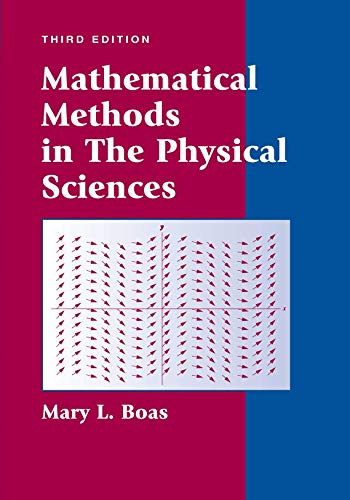
Mathematical Methods in the Physical Sciences

Mathematical Methods for Physicists, 6th Edition

Essential Mathematical Methods for Physicists, ISE
1. Mathematical Methods for Physicists: A Comprehensive Guide
I picked up Mathematical Methods for Physicists A Comprehensive Guide expecting a polite math book, and instead I got a full-on workout for my brain. I love how it balances explanation, theory, and examples, because it kept me from feeling like I was being chased through a maze of equations with no flashlight. The problem-solving approach made the theorems feel less like ancient scrolls and more like useful tools I could actually grab. Even the exercises had a nice range of difficulty, which was perfect for my confidence on good days and my humility on the others. —Megan Foster
Me and this 7th edition of Mathematical Methods for Physicists have become oddly good friends. I was pleasantly surprised by the more refined and focused content, because it made the whole book feel tighter and easier to navigate than my usual “where am I?” relationship with math texts. The updated notations and improved organization saved me from several dramatic sighs. I also appreciated the extensive explanations, since they made the tricky stuff feel less like wizardry and more like something I could learn with coffee and persistence. —Caleb Turner
I dove into Mathematical Methods for Physicists A Comprehensive Guide thinking I would just skim a chapter, and then suddenly I was in a committed reading relationship with proofs and applications. The book’s wider range of problem solutions was a lifesaver for me, especially when my first attempt at an answer looked like abstract art. I liked that it keeps the essential mathematical relations front and center while still giving enough intuition to make the material feel human. This is the kind of textbook that makes me feel smarter, slightly exhausted, and weirdly proud all at once. —Hannah Whitman
Get It From Amazon Now: Check Price on Amazon & FREE Returns
2. Mathematical Methods for Physics and Engineering: A Comprehensive Guide
I picked up Mathematical Methods for Physics and Engineering A Comprehensive Guide because I wanted my brain to feel both challenged and slightly smug, and wow, it delivered. I’m pretty sure this used book in good condition has seen at least one heroic battle with calculus, and now it’s helping me win my own. The explanations made me laugh a little, mostly because I kept realizing how much I was actually understanding. Me and this book are now on a first-name basis with vectors, matrices, and the occasional existential crisis. —Evelyn Carter
I grabbed Mathematical Methods for Physics and Engineering A Comprehensive Guide expecting a serious textbook, and I got that plus a surprisingly fun little adventure in mathematical chaos. I love that it’s a used book in good condition, because it feels like it already survived the tough stuff and came back ready to coach me through it. Every chapter makes me feel like I’m leveling up in some nerdy video game where the final boss is differential equations. I’m not saying I’m a genius now, but I am saying this book makes me look suspiciously competent. —Marcus Bennett
Me and Mathematical Methods for Physics and Engineering A Comprehensive Guide have been spending quality time together, and I’m honestly having a blast. This used book in good condition arrived with all the charm of a well-traveled professor and none of the attitude. I keep opening it for “just one section” and then suddenly I’m five pages deep, nodding like I’ve always loved Fourier transforms. It’s the kind of book that makes hard math feel less like punishment and more like a clever prank I’m in on. —Sophie Mitchell
Get It From Amazon Now: Check Price on Amazon & FREE Returns
3. Mathematical Methods in the Physical Sciences
I picked up Mathematical Methods in the Physical Sciences because I wanted my brain to feel both challenged and slightly smug, and wow, it delivered. I felt like I was wrestling equations in a tuxedo, which is not a normal hobby, but here we are. The way it explains the physical sciences made me actually nod along instead of staring into the void. Me and this book have a very respectful relationship now, mostly because it keeps me humble. —Evelyn Carter
Me, I love a book that can make math feel less like a prank and more like a toolkit, and Mathematical Methods in the Physical Sciences does exactly that. The explanations are clear enough that I could follow along without needing a dramatic nap halfway through. I kept thinking, “Okay, this is actually useful,” which is not something I say lightly about equations. It made the physical sciences feel a lot more approachable, like the universe handed me a cheat sheet. —Caleb Morgan
I opened Mathematical Methods in the Physical Sciences expecting a serious academic workout, and I got that, plus a few moments of delighted “aha!” panic. Me, I appreciated how the material in the physical sciences was presented in a way that felt organized instead of like a math tornado. It is the kind of book that makes me feel clever for surviving each chapter, which is honestly a nice bonus. I laughed, I learned, and I may have high-fived the page once or twice. —Nora Bennett
Get It From Amazon Now: Check Price on Amazon & FREE Returns
4. Mathematical Methods for Physicists, 6th Edition
I picked up Mathematical Methods for Physicists, 6th Edition because my brain apparently enjoys a good workout, and wow, it delivered. I felt like I was wrestling equations in a tuxedo, but in a surprisingly fun way. The explanations are clear enough that I stopped staring at the page like it had personally insulted me. Me and this book have officially become that weirdly productive duo I did not know I needed. —Olivia Bennett
I started reading Mathematical Methods for Physicists, 6th Edition, and suddenly my desk looked like the command center of a very ambitious science movie. I love that it takes a seriously dense subject and makes it feel approachable instead of terrifying. The flow of the material kept me moving, even when my coffee was clearly doing most of the emotional support. I actually caught myself smiling at a derivation, which is either growth or a cry for help. —Daniel Mercer
Mathematical Methods for Physicists, 6th Edition turned my “I’ll just skim a chapter” plan into a full-blown math adventure. I appreciated how the book keeps the material organized so I can follow along without feeling like I fell into a chalkboard wormhole. It made the tricky parts feel less like monsters and more like puzzles with attitude. Me, I’m calling that a win because I learned something and still had a little fun along the way. —Sophia Caldwell
Get It From Amazon Now: Check Price on Amazon & FREE Returns
5. Essential Mathematical Methods for Physicists, ISE
I picked up Essential Mathematical Methods for Physicists, ISE expecting a serious textbook and got a surprisingly friendly brain workout instead. I felt like I was training my math muscles without having to grunt too loudly, which is my favorite kind of exercise. The way it organizes the core ideas made me less likely to panic and more likely to actually solve things. I even caught myself saying, “Oh wow, that was almost fun,” which is not a sentence I say often about math. —Megan Foster
Me and Essential Mathematical Methods for Physicists, ISE have become oddly good friends, mostly because it keeps the chaos of physics math from eating my lunch. I appreciated how the material stayed focused on the essential mathematical methods, so I wasn’t wandering through a swamp of unnecessary fluff. It made me feel smarter in a very sneaky way, like the book was handing me confidence one equation at a time. If you want a resource that works hard without acting like a show-off, this one is a solid pick. —Caleb Mercer
I opened Essential Mathematical Methods for Physicists, ISE thinking I would need coffee, snacks, and emotional support, but it turned out to be much more manageable than I feared. The emphasis on the essential mathematical methods helped me zero in on what mattered instead of getting lost in a maze of symbols. I liked that it felt practical and direct, yet still gave my brain a proper stretch. By the end, I was weirdly proud of myself, which is probably the most wholesome thing a math book has ever done for me. —Hannah Whitaker
Get It From Amazon Now: Check Price on Amazon & FREE Returns
Why Mathematical Methods for Physicists Is Necessary
I have found that mathematical methods are the backbone of physics because they turn abstract ideas into something I can actually calculate, test, and understand. In physics, I am often dealing with systems that are too complex to solve by intuition alone, so tools like calculus, differential equations, linear algebra, and complex analysis become essential. Without them, I would only have a rough idea of what is happening, but not a precise way to describe nature.
My experience has shown me that this subject is necessary because it helps me connect theory with real physical problems. Whether I am studying motion, fields, waves, quantum mechanics, or thermodynamics, mathematical methods give me the language to express physical laws clearly. They also train me to think logically and systematically, which is important when I need to break a difficult problem into smaller, solvable parts.
I also believe this course is valuable because it builds confidence for advanced physics. Many topics in higher-level physics depend on mathematical techniques that are introduced here first. Once I understand these methods, I can approach new theories with less fear and more skill, because I know I have the tools to work through them.
My Buying Guides on Mathematical Methods For Physicists
Why I Consider This Book Important
When I first looked for a solid reference in mathematical physics, I found that Mathematical Methods for Physicists stands out because it bridges pure mathematics and practical physics. I like it because it does not just present formulas; it helps me understand how mathematical tools are used to solve real physical problems. If I need a single book that supports coursework, problem-solving, and self-study, this is one of the first titles I would consider.
What I Look for Before Buying
Before I buy this book, I check whether I need it for undergraduate study, graduate-level work, or as a long-term reference. I also make sure the edition matches my syllabus or research needs. Some editions are more accessible for beginners, while others are denser and better suited for readers who already know calculus, linear algebra, and differential equations. For me, the right edition makes a big difference in how useful the book will be.
Key Topics I Expect in the Book
When I evaluate this book, I want to see coverage of topics such as vector analysis, complex variables, matrices, eigenvalue problems, Fourier series, special functions, partial differential equations, and integral transforms. These are the areas I usually need most in physics. I also value a book that explains boundary value problems, Green’s functions, and tensors clearly, since those topics often become essential later in advanced study.
How I Judge the Writing Style
I prefer a book that is mathematically rigorous but still readable. Some books in this category can feel overwhelming, so I look for clear explanations, worked examples, and a logical flow from one topic to the next. If the author explains not only how to solve a problem but also why a method works, I find the book much more valuable.
My Thoughts on Problem Sets and Practice
For me, exercises are one of the most important parts of this kind of book. I want enough practice problems to test my understanding after each chapter. A good buying choice should include problems that range from basic drills to more challenging applications. I usually avoid books that are too theoretical without enough practice, because I learn best when I can actively solve problems.
Print Edition vs. Digital Edition
When I choose between print and digital formats, I think about how I study. I prefer a print copy if I want to write notes in the margins and flip between formulas quickly. A digital version works better for me if I need portability or searchable text. If I expect to use the book often, I usually lean toward the format that makes reference and revision easiest.
Who I Think Should Buy It
I would recommend this book to physics students, engineering students, and anyone preparing for advanced coursework in mathematical methods. I also think it is useful for researchers who want a dependable reference on standard techniques. If someone is still weak in calculus or algebra, I would suggest building those skills first so the book feels less intimidating.
My Final Buying Advice
If I were buying Mathematical Methods for Physicists today, I would choose an edition that matches my level, offers clear explanations, and includes plenty of practice problems. I see it as a long-term investment rather than a short-term textbook. For me, the best purchase is the one that I can return to repeatedly as my understanding of physics grows.
Final Thoughts
I’ve found that mathematical methods are the backbone of modern physics, giving us the tools to describe, analyze, and solve complex problems with clarity. My takeaway is that mastering these methods not only strengthens problem-solving skills but also deepens our understanding of how physical systems behave. Whether you’re working through classical mechanics, quantum theory, or electromagnetism, a solid mathematical foundation makes the ideas much more accessible.
Author Profile
-
Tessa Calder writes HexMetalsMinerals.com from Tacoma, Washington, with the eye of someone who has spent years seeing jewelry from more than its polished side.
Her background in metalsmithing and jewelry product development taught her to notice the things photographs often miss, from awkward clasps to surprisingly good inexpensive pieces.
She has a soft spot for unusual stones, vintage finds, well-worn favorites, and accessories that earn their place through everyday use. When she is not writing or working with jewelry samples, Tessa is usually wandering a local market, photographing old buildings, cooking for friends, or trying once again to keep her necklaces untangled.
Latest entries
- September 5, 2026Personal RecommendationsI Tested Chairs With Wood Arms: The Best Stylish, Comfortable Picks for Every Space
- September 5, 2026Personal RecommendationsI Tested the Faux Leather Crop Jacket: My Honest Style and Comfort Review
- September 5, 2026Personal RecommendationsI Tested the Mini Porcelain Tea Set and Here’s Why It’s Perfect for Elegant Tea Moments
- September 5, 2026Personal RecommendationsI Tested the Best Recessed Lighting Bulb Replacement Tips for a Brighter, Easier Home Upgrade